Becoming wealthy from holding a single stock is rare. Preserving that wealth is even rarer.1
Many successful investors hold a large, low-basis position built through employer equity, a founder's stake, or decades of appreciation. Selling it can trigger a significant tax bill. Not selling leaves a large share of their wealth riding on one company. Long/short tax-aware strategies are designed to help investors work through that tension.
The Concentration Dilemma
- Behavioral: "Why would I sell the company that made me wealthy?"
- Statutory: Insiders and executives may face trading windows or restrictions that limit what they can do and when.
- Tax: Selling highly appreciated shares can mean a large realized gain, and investors also need a plan for how to reinvest the proceeds.
The result is often inaction. The position stays concentrated because the cost of fixing it feels too high.
How a Long/Short Tax-Aware Strategy Works
These strategies pair a systematic, data-driven stock selection process with a long/short structure. In addition to owning a diversified set of stocks, the portfolio adds long and short positions around the funding assets, putting more dollars to work.
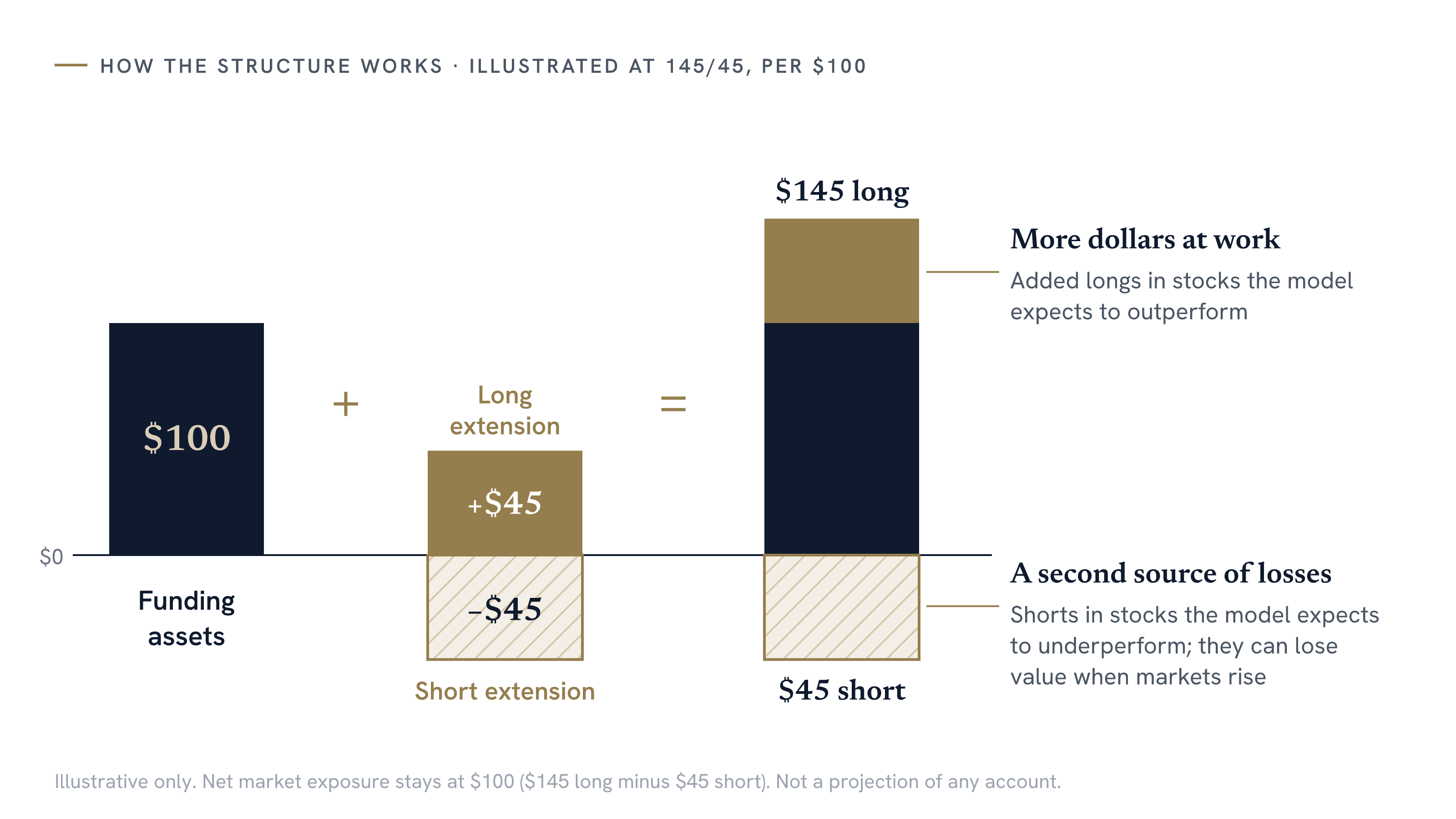
- Long extension: Additional positions in stocks the model expects to outperform, funded in part by the short side.
- Funding assets: Cash, appreciated stock, ETFs or mutual funds, or a concentrated position. These anchor the portfolio.
- Short extension: Positions in stocks the model expects to underperform. Shorts can generate losses when markets rise, a second source of loss potential.
Because losses can be realized on both sides of the portfolio while gains are deferred, the strategy may generate net capital losses even when markets are rising. Those losses are a byproduct of the investment process, and may be used to help offset gains from selling the concentrated stock.2
A 3-for-1 Approach
- Pre-tax return potential. Active, data-driven stock selection designed to seek returns above a chosen benchmark, not simply to track it.
- A tax-aware path out. Realized net capital losses, a natural byproduct of long/short trading, may help offset gains as the concentrated stock is sold down.
- Potential ongoing benefit. Loss generation may continue after the transition, depending on market conditions and the investor's circumstances.
Flexible Ways to Fund the Strategy
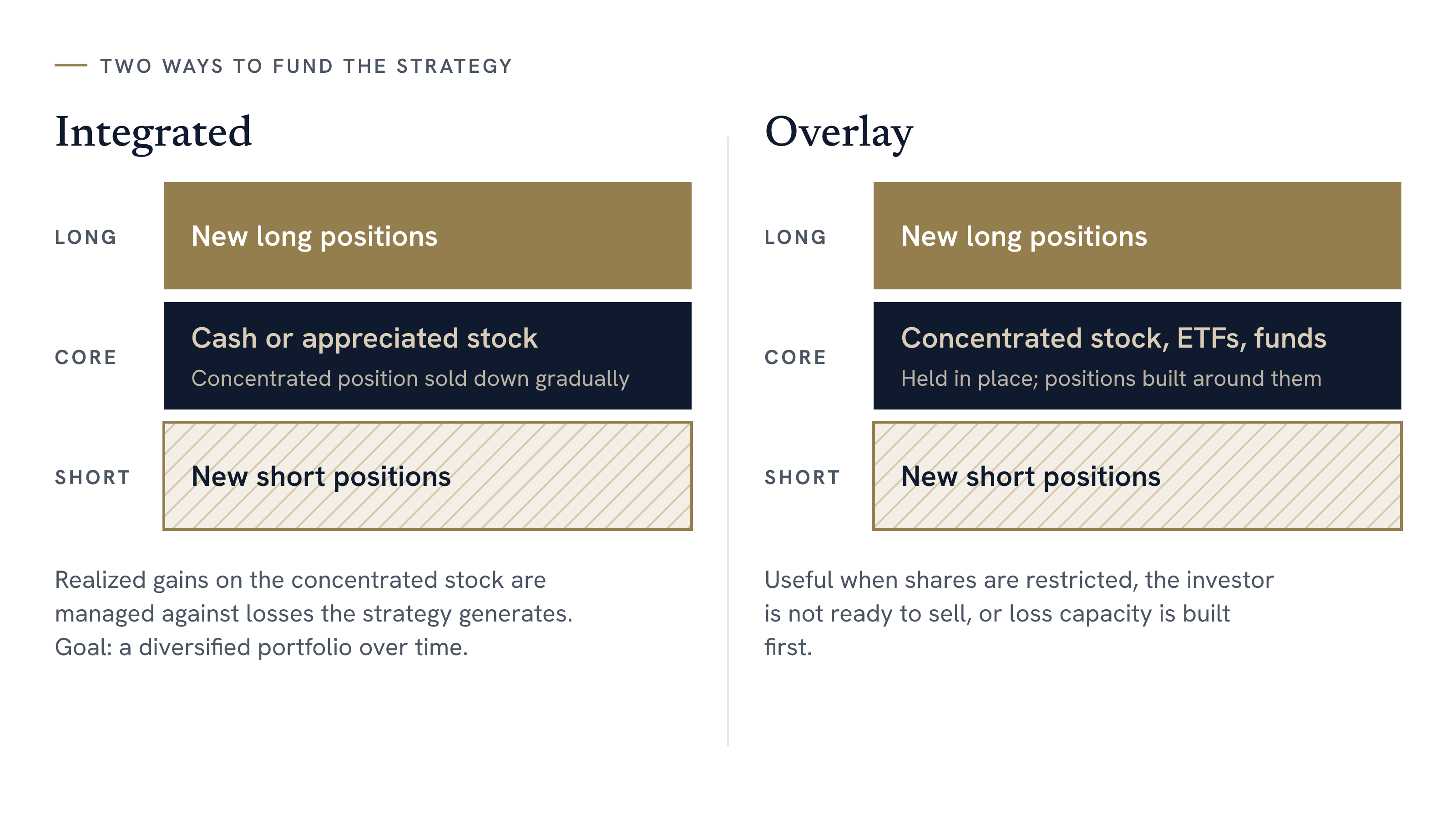
- Integrated: Fund with cash, an appreciated stock portfolio, or a mix. The concentrated position is sold down gradually, with realized gains managed against the losses the strategy generates. The goal is a diversified portfolio over time, without a single large tax event.
- Overlay: Keep the concentrated stock, ETFs, or mutual funds in place and build the long/short positions around them. This can be helpful when shares are restricted, when the investor is not ready to sell, or when the client wants to build loss capacity first.
Investors can also customize the benchmark, the level of active risk, and the leverage structure, and adjust them as needs change (for example, for withdrawals or charitable giving).
Choosing a Level of Leverage
Higher leverage generally increases both the potential for loss generation and the potential for loss of capital. The right structure depends on the account size, the size of the gain to be managed, and the investor's risk tolerance.
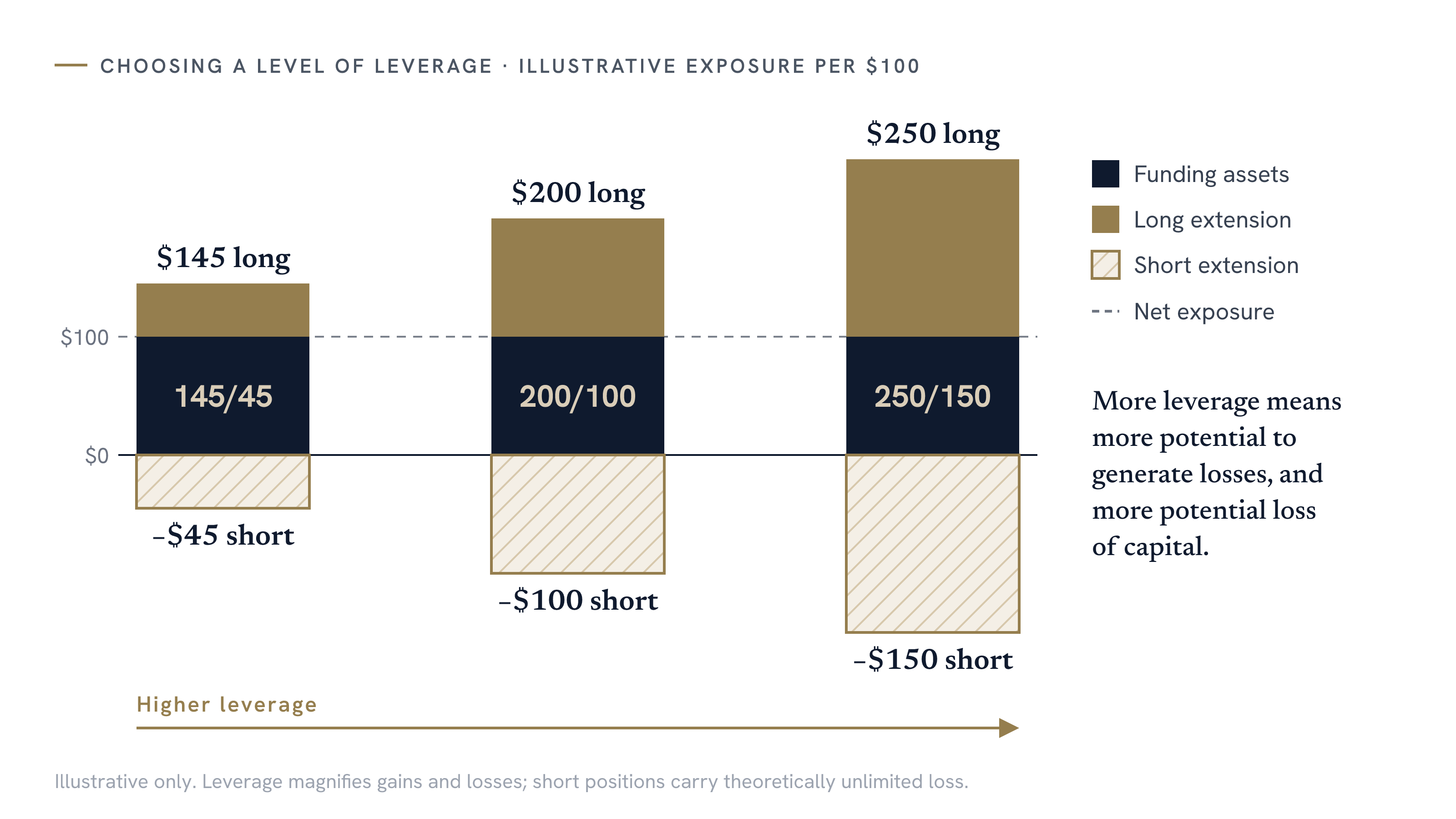
| Structure (long / short) | Illustrative exposure per $100 |
|---|---|
| 145 / 45 | $145 long / -$45 short |
| 200 / 100 | $200 long / -$100 short |
| 250 / 150 | $250 long / -$150 short |
Management fees, advisory fees, and margin costs apply and vary by structure and account size. Ask for the current fee schedule.
Who May Benefit
- Executives and employees with large positions from RSUs, options, or employee stock plans
- Founders and early employees following a liquidity event
- Investors holding long-term, low-basis stock in a taxable account
- Investors expecting a large taxable event, such as a business sale or real estate sale
Important Considerations
- Leverage increases the potential for both gains and losses. Short positions carry the risk of theoretically unlimited loss.
- Tax benefits are not guaranteed. Outcomes depend on market conditions, cost basis, trading activity, the investor's tax situation, and changes in tax law, and the IRS could challenge the treatment.
- Accounts require margin approval at the custodian. Margin interest, short-related fees, and dividend substitute payments apply, and short interest rebates are generally taxable income. Investors should review the tax treatment with a tax professional.
- The strategy may underperform its benchmark. Diversification does not eliminate the risk of loss.
- Concentrated stock may be subject to company trading policies, lock-ups, or securities law restrictions that must be reviewed before any transaction.
Next Steps
A short conversation can help determine whether a long/short tax-aware strategy fits your situation. We can review the size and basis of your position, your funding options, and your timeline, and coordinate with your tax and legal advisors. Contact Manhattan West to start that conversation.
Footnotes
-
Research, including Bessembinder (2018), shows that the most frequent ten-year buy-and-hold return among all U.S. common stocks in the CRSP database from 1926 to 2016 was approximately -100%. Hendrik Bessembinder, "Do Stocks Outperform Treasury Bills?," Journal of Financial Economics, September 2018 ↩
-
On loss realization in actively managed tax-aware long/short strategies, see Stanley Krasner and Nathan Sosner, "Loss Harvesting or Gain Deferral? A Surprising Source of Tax Benefits of Tax-Aware Long-Short Strategies," The Journal of Wealth Management, February 2024 (working paper 2023) and Joseph Liberman, Stanley Krasner, Nathan Sosner, and Pedro Freitas, "Beyond Direct Indexing: Dynamic Direct Long-Short Investing," The Journal of Beta Investment Strategies, August 2023. ↩