
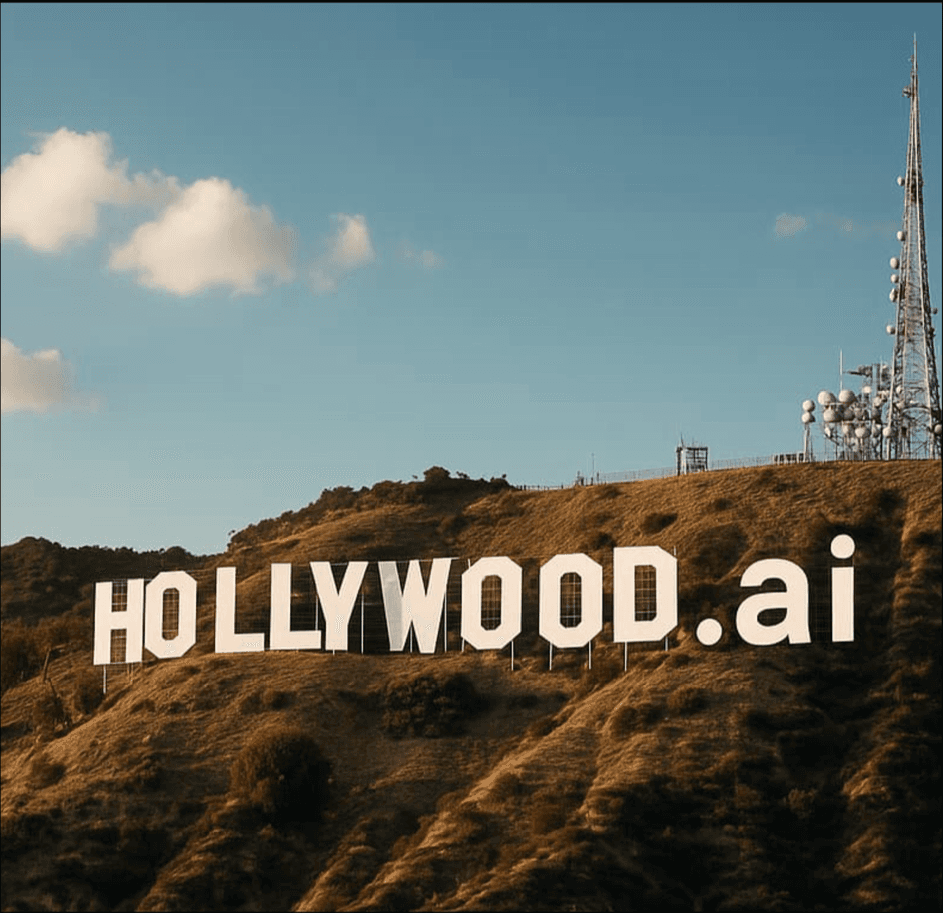
"70% of this episode was made with AI" was the opening line during an exclusive Los Angeles Tech Week event in 2025. What followed was an in-depth conversation on how the technology had advanced over the prior 18 months, from concept to use case and finally to "the future of production." AI has moved from novelty to foundational across the entertainment stack. Text-to-video and video-to-video tools have passed key usability thresholds: anatomic mimicry, voice sync, and, most importantly, consistency. The top three generative-entertainment platforms carry an aggregate value of roughly $510 billion, and the primary talent agencies have adopted what amounts to a "Dutch-door" posture: slamming the top half shut with public opt-outs and hardline statements, while keeping the bottom half ajar for controlled pilots and platform partnerships such as a proprietary rights-management vault built by one of the top talent agencies.
"Our position is that artists should have a choice in how they show up in the world and how their likeness is used, and we have notified the platform that all our clients be opted out of the latest AI video update, regardless of whether IP rights holders have opted out IP our clients are associated with," a senior digital-strategy executive at one of the top Hollywood talent agencies wrote in a statement to press (October 16, 2025).
The Three Pillars of AI in Entertainment
1. State of Technology & Adoption
One leading platform's latest text-to-video model advanced video realism and control and is moving into consumer distribution; a competing model emphasizes pro-workflow and supports C2PA (the Coalition for Content Provenance and Authenticity), which is increasingly becoming a procurement requirement. In parallel, a major video-sharing platform has begun rolling out likeness detection to identify and remediate unauthorized AI videos at scale, signaling that provenance and consent rails are becoming distribution chokepoints.
2. Copyright, Labor & Policy
Guild rules, litigation, and regulation are now gating adoption. The Writers Guild of America's 2023 Minimum Basic Agreement states that AI output is not "source material," preserving writer credit and preventing compelled AI use. SAG-AFTRA's framework with an AI voice-replica platform enables consent-first professional voice replicas. Meanwhile, the Recording Industry Association of America's (RIAA) suits against two AI music-generation startups over training on copyrighted recordings crystallize the risk of unlicensed corpora. The EU AI Act and national measures (e.g., Spain's proposed fines) are pushing labeling and transparency requirements for synthetic media.
3. Agencies as Gateways
Agencies are shifting from pure representation to rights operations. One top talent agency has partnered with an AI data-management vendor to launch a secure repository for clients' scans, voices, and metadata, and has collaborated with a major video-sharing platform on early likeness-detection testing. Another leading agency's internal research arm documents creator attitudes toward AI and has joined its peer agencies in a negative stance on the leading text-to-video platform's latest release, deeming its posture "exploitation, not innovation."
How It Works: The Modern AI Pipeline for Entertainment
The Content Layer: Good In, Good Out
Studios start with cleared assets (with documented consent); these assets are then used to generate or transform media, which is finished inside the same non-linear editor/VFX suites used for traditional post-production. The completed media is then exported with AI metadata so platforms can label, route, or remove content as needed. In this model, AI doesn't replace Hollywood: it formalizes Hollywood's operating model, driving fewer handoffs, faster iteration, and stronger audit trails.
One leading stock-media and data-licensing company's business illustrates how quickly this has scaled: data, distribution, and services revenue tied to AI licensing deals grew from roughly $7 million in 2019 to $16 million in 2021, $39 million in 2022, and $137 million in 2023, with an outlook of $138 million for 2024, according to that company's Q4 2023 earnings report and investor relations materials (2024).
With studios prioritizing licensed and indemnified corpora up front (stock libraries, archives, and performer-approved scans and voices), downstream legal review and platform distribution proceed with less friction. Data suppliers and enterprise vendors have turned "clean inputs" into a commercial moat, and procurement desks increasingly ask how the work was made before they ask what it looks like.
The Hybrid Production Model: "It's the Same Damn Horse Every Time"
During the same Tech Week, one event held at a Culver City soundstage showcased not only the quality of a proprietary model, but also its consistency. A 40-second segment of a one-hour film showed a Clydesdale horse with distinguishable features. That same horse was then shown in five different scenes, each representing a different setting, angle, and mix of real and AI characters. The only consistency on each scene was the Clydesdale and its distinguishing features. The speaker on stage, to everyone's surprise, said the horse "was generated in the cloud [through a proprietary text-to-video model], it does not exist, and it's the same damn horse every time."
To illustrate how significant this consistency was: the simple prompt of "generate a video of Will Smith eating pasta" has generated short clips that increase in accuracy and quality, approaching near-perfection, without the use of a digital twin (an accurate 3D virtual representation of a physical object). It took roughly two years to get a usable base render; it now takes minutes to replicate every aspect of the same base render across any situation.
For on-set production, LED-volume stages combine widely used real-time 3D rendering engines with precise camera tracking. This makes virtual environments move naturally with the camera's position, adjusting lighting and parallax live. Near-final shots can be captured directly in-camera, reducing post-production fixes and keeping shooting days more efficient and predictable. This hybrid segment is then fed into the model layer and used as a basis for other scenes in real time.
On the audio side, AI-driven tools handle everything from speech-to-speech dubbing to voice replication to sound-environment simulation. Neural voice models can preserve an actor's tone and pacing across multiple languages, while automated sound design tools generate ambient layers or Foley effects that match the visuals in real time.
In postproduction, the tools producers already trust have absorbed AI natively. One widely used color-grading and editing suite's built-in AI engine automates person and depth isolation and accelerates rotoscoping, relighting, and subtitle timing. Another major finishing platform layers machine-learning segmentation and next-generation camera tracking onto a pipeline built for broadcast and features. These embedded upgrades cut hours to minutes and reduce handoffs between departments.
The production is complete, and two questions come to mind: who owns the AI-generated content, and how do you track it? Content Credentials (C2PA), a cryptographically verifiable manifest of "who did what, with which tools," can be embedded at export and carried through edits. As platform policies tighten, assets bearing credentials pass compliance faster and avoid relabel and rollback cycles. Platforms are also becoming more active policy enforcers: likeness-detection and synthetic-media labeling allow creators and agencies to flag or remove impersonations while still permitting legitimate, disclosed use.
The Conflict
AI is not the first technological leap in Hollywood to spark an identity crisis. From "talkies" in the 1920s to CGI in the 1990s, the same question returns: who will be replaced? On one side, writers fear dilution of voice, and actors fear the permanence of their digital doubles; history shows a pattern of tools advancing faster than the debate over them, collapsing the space between intent and execution.
In our view, AI in Hollywood will primarily redefine what it means to be "in the industry" by compressing repetitive tasks and upskilling incumbents, rather than reducing headcount outright. Editors, VFX artists, and sound engineers are already evolving into AI supervisors and creative technologists, a shift that should push unions like the WGA, SAG-AFTRA, and IATSE to codify consent, authorship, and compensation as part of this transition.
The next phase of AI in entertainment should be reinvention, not reduction. Jobs should evolve, not disappear; AI should compress inefficiency, not creativity. For studios, this is less about cost-cutting and more about capacity expansion: building faster, safer, rights-aware production pipelines. If Los Angeles aligns capital, policy, and education around modernization instead of resistance, it can remain a global hub for this transition.
The Manhattan West Late-Stage Venture Capital Position
We are cautiously optimistic on AI in entertainment over the next three to five years. In our view, the companies most likely to win will blend creative capability with legal clarity (using licensed data, clear consent systems, and provenance by default) while fitting into existing studio workflows. As AI becomes standard across editing, VFX, and localization, it has the potential to re-anchor production in Los Angeles, cutting costs and timelines while giving the workforce opportunities to upskill with AI-assisted tools.